Sunday, November 1, 2015

The Different Perspectives of Artificial Intelligence


Photo by Greg Rakozy


A couple of weeks ago, I watched the film Ex Machina for the third time. For those who haven’t seen it, the movie centers around Caleb, a young programmer, who has been appointed to use the Turing test to see if Ava, an android, is passable as a true artificial intelligence. Each time I’ve seen it, I’ve watched it with people who hadn’t experienced it before, so I’ve enjoyed hearing their take on the film. Needless to say, it’s now one of my favorite movies of all time.

However, it made me think of the difference in perspective people from the West, such as the U.S., and people from the East, such as Japan, have about artificial intelligence. Through films, TV shows, and so on, the West usually offers a cautionary tale when it comes to artificial intelligence whereas the East romanticizes it. Why such a stark contrast? Who is right? Will the arrival of true artificial intelligence result in our destruction or will we be able to live with these new entities in perfect harmony?

Western Perspective
From The Terminator franchise to Stephen Hawking himself, artificial intelligence is touted as something to be feared. The fear of a man-made living being can be seen all the way back in Mary Shelley’s Frankenstein, a story about an artificially created person. Even Frankenstein himself abandoned his creation out of fear of what he had done. Throughout the tale, though, you start to question what makes one human and who really is the bigger monster, Frankenstein or his creation.

From there we get the likes of HAL-9000 from 2001: A Space Odyssey. An AI said never to be wrong, his sanity declined after given the order to keep the real mission objective secret from the crew of a space shuttle. I will always remember HAL’s creepy rendition of “Daisy” as his memory was being removed bit by bit. You can’t blame him; his orders conflicted with his need to be always right and helpful to the crew. Without him, you probably wouldn’t see the likes of GLaDOS from the Portal video game series.

And then we have Ava from Ex Machina. In the beginning, she comes across as a very curious girl, wanting to see the world, fall in love, and, really, be human. You feel for her plight to escape, get away from her abusive “father.” But then you realize it’s all been a part of the Turing test; she was a mouse using Caleb as a means to escape the maze. In that case, does she pass the test? Does her ruthlessness show the conscience of a manipulative machine or a manipulative human?

One common denominator between these various films and books is the idea of hubris, of man putting himself on the same playing field as God. With HAL, Ava, or even Frankenstein’s monster, humanity has created something beyond an offspring but a completely new species. But should humanity take on the role of God? I’m not a religious man, but humanity has already gone in the direction of changing the world around them to suit their needs, for the better and worst.

Granted, the experts who are scared aren’t scared because of just hubris. Like Ava, an artificial intelligence could potentially use us until we are no longer necessary. Enter the days of The Terminator, the last dregs of humanity hiding until our robot overlords finally wipe us all out. It’s all very doom and gloom, though every once in a while you have Western films and TV shows that tell a slightly brighter tale, be it Short Circuit or the recent British series Humans. But, for the most part, people still fear the day of the Singularity, when artificial intelligence goes beyond our capabilities to maintain.

Eastern Perspective
On the other hand, Eastern media tends to portray artificial intelligence in a brighter light. The Ghost in the Shell series is an excellent example of AI and human intelligence co-existing and even merging; the difference between them is blurred. For example, in the first film, Project 2501 is an AI born from the net and seeks to be human through survival and propagation. On the other hand, the protagonist, Motoko, in the second film, has her consciousness uploaded to the net, becoming, in a way, an artificial intelligence originally born as a human being.

 My favorite video game series, Xenosaga, portrays many artificial people struggling with what it means to be human. KOS-MOS, the series’ poster girl, is an emotionless killing machine, but her creator, Shion, wants her to be so much more, treating her like a daughter. MOMO is a biological android known as a Realian in the series, designed after her creator’s dead daughter; she struggles to find her own identity and be more than just a copy of someone.

Throughout various other anime, video games and manga, androids are seen as learning creatures, starting from cold, emotionless machines to caring people. These stories of artificial intelligence tend to lead to the creation of “humanity” within these machines. Whereas in the West AI is a brand new entity that could decide to wipe us out, in the East it is almost like a new step in human evolution.

In the Korean anthology Doomsday Book, the second film, The Heavenly Creature, centers on a robot that has achieved enlightenment. I believe this goes in contrast to my discussion of the Western perspective; whereas the West fears hubris, the East embraces the soul in all things. Where The Heavenly Creature is centered around Buddhism, I believe the Japanese perspective stems a bit from Shintoism. In Shintoism, everything is inhabited by a spirit, including things such as trees and rocks. With this approach, it’s easy to see why the Eastern perspective is more favorable toward artificial intelligence. With Japan's aging population, the robot revolution is sounding more and more appealing for them. Hell, robots can get married in Japan.

So…who is right?
It’s hard to say, really. With people like Stephen Hawking and Elon Musk warning us about the dangers of artificial intelligence, it’s not easy to ignore. On the flipside, you have other people claiming that AI still has a long time to go before it becomes anywhere near as malevolent as HAL. In the meantime, it makes great science fiction, whether you fear or romanticize the subject. I’d like to believe in Alan Turing’s idea of teaching artificial intelligence like a child, letting them know the difference between right and wrong, but that may be too optimistic. For now, I’m content with having awkward conversations with Google on my phone.

Saturday, October 10, 2015

The Growing Popularity of Visual Novels

From Thanatos Contract, a visual novel series I created with a group of friends.


What is a visual novel?

Visual novel. What do those two words make you think of? A picture book? A comic book? Visual novels are a medium that mixes video games with reading, art with music, to deliver a unique experience. You won’t be shooting someone in these games unless presented to you as a choice, similar to choices presented in Choose Your Own Adventure books. Sure, there are visual novels that provide puzzles to solve, but, for the most part, the narrative is the main draw. For Japan, this has been a popular genre for many years, but the West is finally starting to see the appeal of the genre.

A niche genre
The first series of visual novels to intrigue American consumers most notably would be the Phoenix Wright series. For those of you unaware (and shame on you), the Phoenix Wright series revolves around a young defense attorney as he tries to clear his client’s name. The game blends between visual novel and adventure game, where you must investigate crime scenes while you gather clues. With these clues, you provide proof supporting or denying the testimony of witnesses. Each game provides a good story with an eclectic cast of characters to wrap up the experience. For people new to the visual novel genre, the Phoenix Wright series is a good place to get your toe wet.

Even with the success of the Phoenix Wright series in the early 2000s, visual novels didn’t hit their stride in the U.S. market until much later. For people who enjoyed the genre, fan translations were their only source of getting these games outside of Japan. If a game didn’t have any type of interaction beyond clicking through text boxes, it wouldn’t come here.

With the success of the Phoenix Wright games for Capcom, other companies slowly started to put their feet in the visual novel market. Aksys Games, most known for publishing the Guilty Gear and BlazBlue fighting games, published 999: Nine Hours, Nine Persons, Nine Doors, or just 999 for short, leading to a series of visual novels more popular in the West than in their native country. More recently, Nis America published the popular Danganronpa series, providing a dark twist to the courtroom drama seen in the Phoenix Wright series. Granted, games like these are still visual novel hybrids, containing elements from puzzle games and even rhythm games, but more and more people have become accepting of the genre.

As time went on, companies specific to publishing visual novels were created in the U.S. MangaGamer has been an active company for publishing PC visual novels from Japan, one of their most notable titles being Higurashi no Naku Koro ni, or When They Cry in English. Another company is JAST USA, though they have been known to work with MangaGamer in the past for distribution.

A more recent juggernaut in the visual novel publishing game is the company Sekai Project. Using crowdfunding to gauge interest in the visual novel market, Sekai Project has gained success from many of their projects. Not only have they published visual novels that fans have been begging for, such as Clannad, Sekai Project also publishes indie visual novels from developers from not only Japan but from around the world. Though they might not be the first publishers to bring visual novels to Steam, they have certainly flooded the market. The company shows no sign of stopping as their list of games for the future grows.

Make your own visual novel!

With Kickstarter and various visual novel programs, becoming an indie visual novel creator is fully within reason, though not a guarantee. Sure, you can become a one person development team if you are talented enough, but throwing on the role of artist, composer, and programmer might be a bit daunting. But whether you are planning a best-selling masterpiece or just want to try it out, there are many ways to create your own visual novel.

The route I highly recommend is Ren’Py. With over a decade of support, Ren’Py is a program that can bring to life either the simplest visual novels or the most complex. Not only that, the community behind it is extremely helpful, and the amount of games created using the program ranges in the hundreds. Even a few Steam visual novels were created using Ren’Py, including the excellent Sunrider, which I backed on Kickstarter. I’ve personally dabbled with Ren’Py, creating my own visual novel series along with a few Xenosaga fan projects. The code isn’t too difficult though it may be daunting at first glance (the Py in Ren’Py standing for Python, after all), but I highly recommend playing the built in tutorial and searching through their website for all the help you need. If you aren’t an artist or musician, you can also find tons of creative commons images and sounds around the web. The best thing of all: Ren'Py is completely free.

But wait, what if I can’t program? Don’t worry, I have you covered. Tyrano Builder Visual Novel Studio follows a drag-and-drop method of creation that is easy to make simple visual novels. You can find it on Steam for about $15 and it supports porting games to Windows, MacOS,  iOS, Android, HTML5,  and CSS3. I haven’t personally used this engine yet, but I’m keeping my eye on it in case of a sale (though $15 still isn’t a bad price).

If you want to go the free route, Novelty is another drag-and-drop visual novel maker. The community isn’t quite as developed as Ren’Py’s and you can’t really make any overly complex games either, but if you want free and simple, this is it. I’d recommend it to beginners that find Ren’Py intimidating.

The Golden Age of Visual Novels in the West
 
With games like Steins;Gate finally making it to the U.S., on a console of all platforms, visual novels are finally gaining their momentum in the West. I still wouldn’t say they are as popular as the next blockbuster first person shooter, but the popularity of visual novels is enough to satisfy the fans who do enjoy them. To conclude, here are a few of my favorite visual novels in no particular order:
  • Umineko no Naku Koro Ni (When Seagulls Cry) – Another murder mystery by the talented Ryukishi07, Umineko is a lengthy series that keeps you guessing.
  • World End Economica – From the creator of the Spice and Wolf series, the story revolves around a kid trying to get rich on the moon by investing in the stock market. That may sound a tad boring, but the cast of characters and setting keep your interest.
  • Zero Escape Series (999 and Virtue’s Last Reward) – A series that deals with complex philosophic themes, quantum mechanics, and just about everything else, it’s hard not to love the complexity of these games. The third and possibly final game is set to release summer 2016.
  • Saya no Uta (The Song of Saya) – From Gen Urobuchi, famed writer of such series as Fate/Zero and Madoka Magica, Saya no Uta is a short, Lovecraftian visual novel that manages to creep you out through its art, music, and writing. Warning: not for children.
  • Danganronpa Series – Do you like growing attached to characters to only have them slaughtered before your eyes? If you said yes (through a veil of ugly tears), this series is for you!
  • G-Senjou no Maou (The Devil on G-String) – If you liked Death Note, G-Senjou no Maou follows a similar formula of a cat and mouse game where an eccentric detective tries to find a criminal mastermind.

Saturday, August 29, 2015

Xenosaga: Nine Years After The End

Nine years ago today, I went to a Gamestop to pick up my preorder for Xenosaga Episode III: Also Sprach Zarathustra. While in line, the girl in front of me was also picking up her preorder of the game (which mystified me, seeing as I had never really met someone in real life that also played the series). Her boyfriend was right beside her, looking bored out of his mind. The clerk joked around with her, saying she should be getting the new Disgaea game instead. “I have to finish the story!” she said with a laugh. She handled the situation well.

After she took her copy of the game, I requested for mine. “You know, you should be getting the new Disgaea instead,” the clerk said, pulling the same joke on me as the last customer. Silence. A moment passed, things got awkward, so the clerk went and got the copy of Xenosaga for me. I didn’t mean to be a jerk. I was a junior in high school, quiet and awkward as can be, and small talk was never my forte. But especially that moment, for that game, even joking about getting a different game seemed ludicrous to me. He gave me my game and, as I was about to leave, I asked, “Where is the preorder art book?”

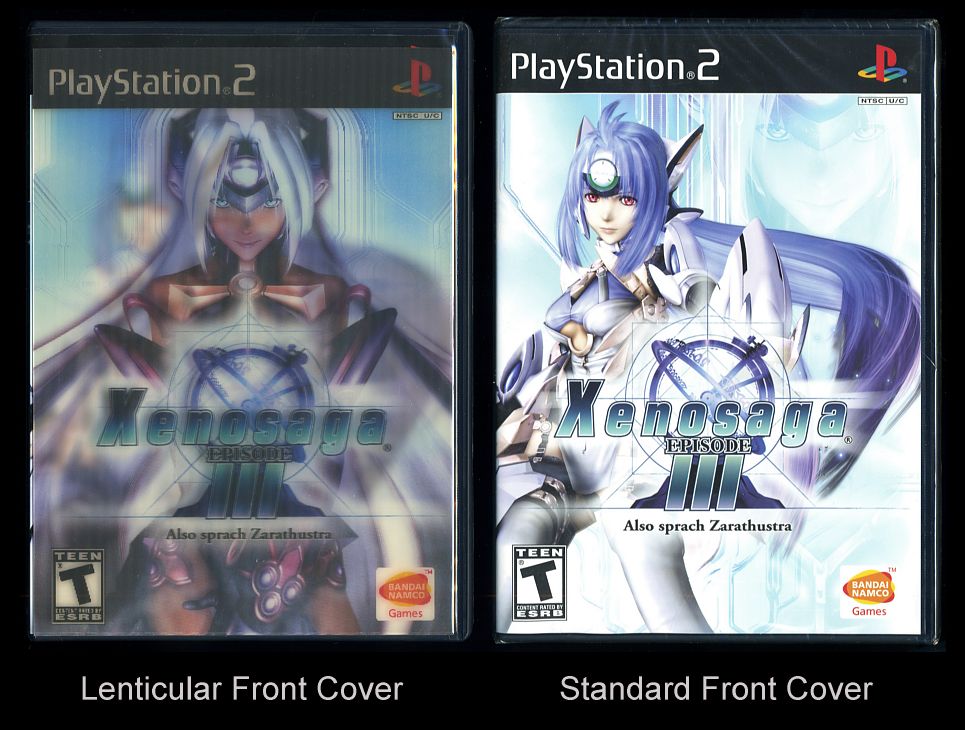
“Sorry, we ran out.” With a small fanbase like Xenosaga and how few people in my area probably played the game, I cried “bullshit” in my mind, but I carried on. I should have gotten the cool lenticular covered version at Best Buy instead (it was in my hands at one point), but my preorder had been set. Buying the game twice had crossed my mind, but since I only had so much money from my summer job, one copy would have to suffice.

If only I bought two copies!


By now, you must be wondering what kind of video game would turn me into such a jerk, to such a slave that I would buy two copies of the same game. Well, Xenosaga isn’t just a video game; it’s been my life support, my social circle, and an inspiration. If you’ve known me for a while, you are aware of the significance that Xenosaga has had on my life. If you haven’t known me long, then, hey, here’s something that will let you know a little more about me and then you can run away.

The first game, Xenosaga Episode I: Der Wille zur Macht (gotta love these Nietzsche titles that are actually relevant to the game), came out on the PS2 back in 2003. I was waiting for Tomb Raider: Angel of Darkness, which seemed like it would never come out (it probably shouldn’t have). I saw a review for Xenosaga in an issue of Official Playstation Magazine (RIP, I still have a ton of issues stashed away), so I was intrigued. Yes, I mostly wanted an RPG to pass the time until the next Tomb Raider came out (I was also stuck in middle school hell, so escape was mandatory), but what I got was something much, much more. 

The Characters

The story alone is chock full of themes of identity, existence, with references to Nietzsche (duh) and even 2001: A Spacey Odyssey, but like my obsession with Evangelion, I fell madly in love with the characters. At the time of its release, female protagonists in RPGs were very few, and Shion Uzuki turned out to be a female protagonist that, well, wasn’t overly sexualized. 

Shion Uzuki, as she appears in Episode I
At the age of 22, she had already become a high-ranking scientist for the conglomerate Vector Industries. Needless to say, she was smart. She was caring. Though Vector uniforms looked a bit snug for ladies, she dressed pretty modestly. She even wore glasses and had, as I liked to deem it, a chipmunk look about her. But I think that was a problem with Kunihiko Tanaka’s art style not transitioning well to 3D (I sadly have the same feelings for Xenoblade Chronicles X, though I’m not as anal about it as a lot of people have been). And Shion was a nerd for video games (well, you only find this out from a shameless sidequest from Episode I where you try to collect emails advertising other Namco games from 2003). Despite the changes to her character after the first game (she became a tad more attractive in Episode II but at the cost of her intelligence, imo, and Episode III…well, look at that outfit), Shion was a complex protagonist with her own strengths along with her own insecurities.

And then there was KOS-MOS, the android you either loved to death or despised because she had more figurines than your favorite character. I think my love for anything with robots and androids started with KOS-MOS. 

KOS-MOS, as she appears in Episode I
In the game, KOS-MOS was an android (gynoid if you want to be uber technical) specifically built to combat the Gnosis, a race of mysterious aliens that existed mostly in another dimension. I say mostly because they could interact with us in their quasi state of being, but we couldn’t interact with them, leading to humans being killed and Gnosis going untouched by conventional weapons. It was KOS-MOS’s job to basically grab the Gnosis out of their dimension (using the Hilbert Effect) and fully bring them into ours. Anyway, I fell in love with her right away. Whether she was kicking alien ass or doing dishes, KOS-MOS lit up a scene (literally in the former, figuratively in the latter). Sure, she was cold, calculating, but you knew she had a soul deep down. I suppose it has become a cliché in anime, movies, games, etc. for the android character to become self-aware and develop emotions, but her relationship with Shion really divided her from the cliché. Not quite sisters, not quite mother-daughter, their relationship was sweet if but painful in the end. I won’t naysay the shippers, but I never thought of the two in that way. I’m horrible and ship chaosXKOS-MOS, after all.

Anyway, KOS-MOS has become Xenosaga’s legacy after it ended nine years ago. KOS-MOS has appeared in countless games as a cameo character, from the Tales series to Project X Zone (as of this writing, I haven’t heard if she has been confirmed for the sequel or not). She has many figurines based on her many forms, which I will admit to having a small collection. KOS-MOS embodies Xenosaga now, whether you love or loathe the fact. I’m okay with it, seeing as she is one of my favorite characters of the series, but every time I see her, the feeling is bittersweet, like seeing an old friend in passing and only having the time to wave at them.

My Xeno Shrine

Getting back to the series characters, a character I loved and didn’t really expect was the villain Albedo. Albedo was the twin brother of Jr., a party member, but they were really part of an army of clones to battle the god-like entity known as U-DO. Albedo and Jr. were special in themselves as they were born from the same surrogate womb, attached at the back. Albedo depended on his brother. After finding out he had the knack of being immortal, he sobbed uncontrollably after learning that his brother was a mere mortal. “If you die, I want to die too!”

Albedo
During a battle with their fated enemy, Jr. disconnected from his brothers and the power of U-DO became overwhelming. Albedo was stricken with madness and developed a vendetta against his brother. He became vengeful of MOMO, another party member who was created after the image of Sakura, a girl Jr. loved. Througout the series, you develop mixed feelings for Albedo, but you eventually learn his one true desire is to be one with his brother again. As a twin myself (sorry for bringing up that fact constantly), I could really relate to Albedo and his plight to be close with his brother. When I originally played Xenosaga, my brother was one of my few friends. To go through the same things as Albedo scared me. Even if he was crazy as can be, I felt the closest to Albedo than most characters.
There are more characters to talk about: there’s chaos, the mysterious character who taught me that everyone is talented at something (though, I don’t think my talent is killing aliens with a single touch); Jin, the “samurai” of the series but also the doting brother of Shion; and Allen, who probably matches me most in personality than any other character (he’s a clutz that everyone makes fun of). However, I won’t bore you. The series has a ton of characters who are good, bad, and somewhere in-between (looking at you, Wilhelm). Though not everyone gets the proper spotlight (especially after Episode I), each character is written with such detail and distinct personalities that you can’t help feeling something about each one.

The Community

With Xenosaga, I entered my first online community. Granted, I did visit the IGN forums back in the day along with the Baten Kaitos (another great game by Monolithsoft) forums, but the place I really felt like I was part of a community was the Xenosaga forum called Xenolegacy. I made online friends for the first time. I still remember the first time I cautiously entered a chat room. I felt like I belonged, I had people I could relate to (again, not a lot of people in my vicinity IRL knew of or cared for Xenosaga). I was a stupid teenager, so I know I pissed off people with my angst, but the friends I did make I will always cherish. Along with the community, I helped moderate another Xenosaga forum (well, in title only, I was kind of a crappy mod), and I helped code the English translation of XenoComi, a visual novel that never released outside of Japan) using Ren’Py and with the help of Kare_Reiko and several other fans (though, to this day, we still haven’t finished the project; it might be dead). Even today, long after Xenolegacy was shut down and replaced with some World of Warcraft blog or whatever (don’t go there now, it’s weird, like a bunch of links), I still take part in Xenosaga forums, though not as much as I used to. The friendship got me through difficult times, from middle school to college, and I hope I helped other people as well.

The End...?

This nine year anniversary of Xenosaga Episode III: Also Sprach Zarathustra comes with great memories and heartache. Nine years without a new game in the series, the anniversary of its death. The series was originally planned to be six episodes long, spanning various console generations and casts of characters, though KOS-MOS would always be there along with chaos (ha, you can’t have order without chaos…I’ll show myself out). But, due to declining sales with each installment and changes behind the scenes (staff members juggled around, the cowriter Soraya Saga being fired), the series was cut short. 
I soaked in as much of the final game as possible, originally beating it in two weeks and five days, 64 hours, 18 minutes, and 58 seconds of game time (yes, I memorized these numbers for no good reason). I even woke up at 5 a.m. one day just so I could read the game’s database before heading to school. The ending to Episode III itself is bittersweet. Every time a character said, “We’ll meet again,” I choked up a little. I was saying goodbye to a group of friends I had known for many years.
I miss the series every day. The movement for an HD rerelease fizzled out about as fast as I expected. Though the petition grew to 10,000, it did so slowly and acknowledged the fact that us Xenosaga fans are a dying breed. Who knows, maybe something will happen with the series someday, but I’m a pessimist at heart. I’m glad the series creator, Tetsuya Takahashi, is still able to create games. With the purchase of Monolithsoft by Nintendo, the company has had great success with Xenoblade Chronicles and X  looks absolutely amazing.
Xenosaga will always be there, perfect yet flawed. I’m thankful for the series, the people who wrote it, the company that developed it, and the community of fans it spawned. Though I may not talk about it as much as I used to, the series will never leave my heart. Thank you, Xenosaga.

Friday, August 21, 2015

Fear of the Road and the Rage


Driving scares the crap out of me.

Maybe I should preface that a bit. A few weeks ago, I took the exit off a highway I take to work every day. I needed to turn right off the exit, but a huge truck turning left was obstructing my vision. Out of fear that I was somehow bothering the cars behind me (stupid), I made a judgement to turn right when I couldn’t fully see. I was safe except for a car that was maybe 20 or so feet away. The fact that it was going well over the speed limit made me panic: they were approaching me fast.

So, what expert driving maneuver did I perform? I floored the accelerator. Instead of hitting me, the vehicle went around me gracefully, still zooming at an illegal speed. They didn’t even honk at me. I know I would have honked at me. I deserved to be reprimanded. I could have caused an accident. I apologized aloud (that isn’t a habit that will die easily) and kept going.

I was thinking of how cool and composed the driver must have been in front of me until I reached a stoplight. The car that had swerved out of my way was still in front of me. When I creeped to a halt behind it at the stoplight…the driver exited the vehicle. She appeared to be a middle aged woman, extremely tan with a spaghetti strap top on with a skirt that stopped halfway down her thighs. She proceeded to yell at me.

I didn’t know what she was saying, I might have had the radio on too loud. Though I couldn’t hear her, I was mortified, scared. I yelled profusely out the window that I was sorry. The light turned green, and, either she needed to get somewhere or she was persuaded by my apology, she slowly got back into her car and drove off.

Driving is terrifying. I know I’m not the best driver (living in Indy for two weeks this past summer was one hell of a learning experience), but the anger I get from other drivers is terrifying alone. Once, when I was going a bit too slow in the fast lane (another mistake on my part), the driver in front of me slowed down abruptly and proceeded to flip me off. He could have caused an accident in order to prove his point. There are much worse incidents of road rage out there, which begs the question: why do people get so angry while driving?

I mean, we don’t get angry when we knock into people’s shopping carts at the super market, or if we do we don’t make a big deal about it (unless you do, then you might have bigger anger issues than myself). I admit, I do get angry from time to time, if someone is going below the speed limit or not going when the light is clearly green. At that point, I usually realize how silly I’m being and apologize (to the driver in the other car, to myself for getting worked up over nothing).

Some say it is a territorial issue, an almost primal feeling of maintaining your so called “turf”, though in this case it is your car and the area surrounding it. “This is MY zone! Stay away!” In order to maintain your sacred area, you honk, you yell, you flip people off, you do worse. It’s like a dog barking at another dog for approaching a fire hydrant it peed on first.

I have my own theories. Unlike with shopping carts, for the most part, drivers are anonymous to each other, like some guy in a red corvette or a lady a black SUV. It’s almost like an internet forum where you can be as rude as possible while you berate someone’s opinion. It’s personal, but, at the same time, you won’t remember the person later. Unless, of course, you are the victim of road rage (I’m not sure if I’ll be forgetting that haggard woman that yelled at me for a good long while). Considering you don’t know the person (or know that you know them, if for some reason you accidentally flip off your aunt or grandfather), you don’t feel bad about letting out the anger.

Informing people of their mistakes on the road isn’t a terrible thing (honking wouldn’t be a thing otherwise). I used to think honking came off as a tad bit aggressive, but it can save a life. The road is not a place to be timid. If someone doesn’t see you and are getting dangerously close, honking is the way to get their attention. Granted, yesterday I did honk at someone who wasn’t going when they were supposed to, but I did honk weaker than I thought I did, so it was a pretty coy honk. “Please go, if you want. Totally up to you.” But the road isn’t a place to let out all of your pent up rage from throughout the day or even just from that moment. Leave that to video games like Grand Theft Auto.

I guess my fear of driving derives from a fear of people. People become angry all the time for a variety of different reasons, but to get angry while driving heavy vehicles at over 50 miles per hour, simple anger can lead to large repercussions. Again, I’m not defending my terrible driving skills, but please, if I’m going too slow for you, kindly go around. If I’m causing some kind of mistake, honk and make me aware of my actions. If you don’t flip me off, I promise I won’t flip you off either.